Last Updated on October 22, 2026 by Homegrown Florida
We all have things competing for our time. Work, kids, family, holidays, appointments, and everything else that somehow ends up on the calendar. But that doesn’t mean you can’t grow some of your own food. In fact, if you’re a busy gardeners, I think choosing the right vegetables is even more important.
There are crops that need constant pest checks, regular fertilizing, careful watering, and quite a bit of patience. And then there are vegetables you can plant, give them a decent start, and mostly leave alone.
Those are the vegetables we’re talking about today. I’m ranking ten of my favorite easy fall and winter vegetables, starting with the ones that require a little bit of work and working our way down to number one, which is about as close to zero effort as I think you’re going to get in a vegetable garden.
And no, you won’t see broccoli or cauliflower on this list. I grow both of them here in Florida, but I wouldn’t call either one particularly low maintenance. They’re wonderful cool-season vegetables, but if you’re specifically looking for crops that fit into an already packed schedule, there are much easier choices.
Table of Contents
This post may contain affiliate links. Read full disclosure here.
What Makes a Vegetable “Easy” to Grow?
For this list, I’m looking for vegetables that don’t require a lot of ongoing attention. Ideally, I want something that:
- Can be direct seeded
- Germinates reliably
- Doesn’t require constant fertilizing
- Doesn’t need complicated pruning or maintenance
- Produces relatively quickly
- Gives you a good harvest for the amount of space and effort involved
- Can tolerate you occasionally forgetting it exists
Some vegetables check almost all of those boxes. And fall and winter happen to be a great time to grow many of them.
Why Fall and Winter Are Some of the Easiest Growing Seasons in Florida
Florida’s cool season gives us a completely different vegetable garden than summer. This is when we can grow carrots, lettuce, cabbage, kale, collards, peas, radishes, and many of the other crops that struggle once our temperatures climb.
The exact timing depends on where you live in Florida. North Florida has a much colder winter than South Florida, while Central Florida can be somewhere in the middle depending on the year. But if you’re looking for an easy garden that doesn’t require your attention every five minutes, cool-season vegetables give you some fantastic options.
Let’s start at number ten.
#10 Carrots
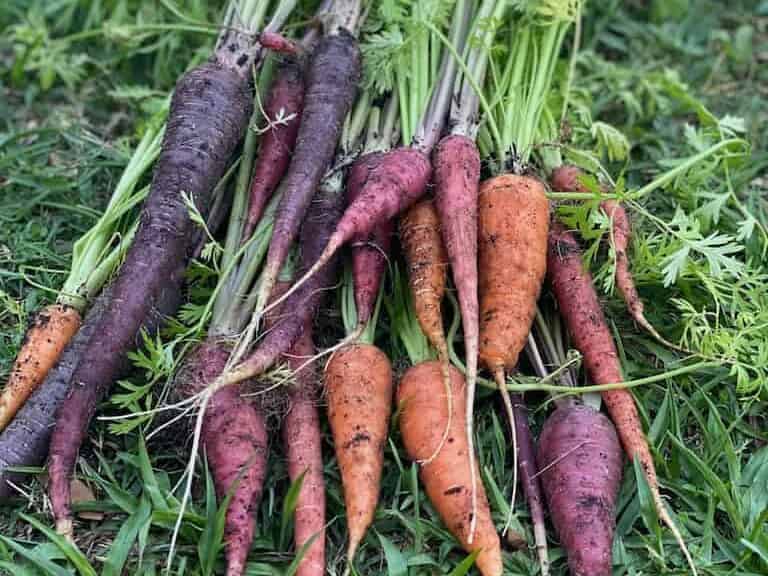
Carrots are a little sneaky. They aren’t difficult to grow, but they do require some attention in the beginning. That’s the only reason they’re starting at number ten instead of being much higher on my list.
The hardest part is getting them to germinate. Carrot seeds are tiny, and you sow them fairly shallowly. That means the surface of the soil can dry out quickly, especially if we’re still dealing with warm Florida weather when you plant them. For approximately the first week, I’m paying attention.
I prepare the soil so it’s loose enough for the roots to grow down without fighting through hard clumps. I’ll add the nutrients the bed needs before planting. Carrots don’t need a ton of nitrogen, but potassium and phosphorus may be important depending on what’s already in your soil. You can also keep things simple with an appropriate all-purpose fertilizer.
Then I sow the seeds and keep that upper layer of soil consistently moist while I’m waiting for germination. This is the needy part. Once I see those little green sprouts?
Good luck, carrots. You’re on your own. I don’t continually fertilize mine throughout the season. Once they’re established, they’re one of those crops I can mostly leave alone until it’s time to harvest.
So carrots aren’t completely zero effort. You just have to baby them for a short period at the beginning.
#9 Kohlrabi
If you’ve never grown kohlrabi before, this is one of those vegetables that looks like it came from another planet. Maybe that’s why grocery stores don’t sell much of it.
Kohlrabi is in the brassica family along with vegetables like broccoli, cauliflower, cabbage, kale, and collards. But I find it considerably easier than broccoli or cauliflower. You can direct sow the seeds right into the garden, give them some nitrogen, and let them grow.
Blood meal can work well if your soil needs additional nitrogen, or you can use an all-purpose fertilizer. There’s no complicated training or maintenance involved, and kohlrabi doesn’t require much space because the plants stay relatively compact.
The result is this strange round vegetable that develops right above the soil. If you’ve never eaten kohlrabi, I’d describe it as something like the texture of an apple with the flavor of broccoli. It’s crunchy and mild, and because it’s difficult to find at a normal grocery store, it’s also one of those vegetables that actually makes sense to grow yourself.
If you want to grow some of the less common vegetables along with the traditional ones, I cover 30 different vegetables and exactly how I grow them in Florida in my Homegrown Florida Gardening Guide.
Kohlrabi is one of the easiest ways to branch out from the vegetables everyone else is growing without adding a bunch of work to your garden.
#8 Cabbage
We’re staying in the brassica family for number eight.

Cabbage requires a little more patience than kohlrabi, but not necessarily more work. For Florida, one variety I like is Early Jersey Wakefield. You can direct sow cabbage, and once the plant is established, most of the work is simply making sure it has enough nutrition to continue growing.
Cabbage is a heavier feeder than kohlrabi, particularly when it comes to nitrogen. I’ll give it nitrogen at planting with something like blood meal or use an all-purpose fertilizer. Then, about halfway through the growing season, I may give it some liquid fertilizer such as fish emulsion. And that’s about it.
The frustrating thing about cabbage isn’t the amount of work. It’s waiting.
For a while, you’ll have this plant producing leaf after leaf after leaf, and you’ll wonder if it has any intention of making an actual cabbage. Then the center leaves finally start curling inward.
Once that happens, you’ll see the head begin developing. If you’re busy, maybe cabbage is actually perfect because you’ll have plenty of other things to distract you while it’s taking its sweet time.
#7 Collards
Collards move us into another category of easy vegetable: plant it once and keep harvesting from it. I love vegetables like this.
Collards can be direct seeded into the garden or grown in a grow bag, but give them some room because these plants can get big. Really big. The advantage is that one plant can produce an incredible amount of food.
Unlike cabbage or kohlrabi, you don’t need to harvest the entire plant. With collards, I harvest the older outer leaves and leave the younger growth in the center. The plant just keeps producing.
You can harvest it pretty aggressively too. I’ve taken plants down to just a few leaves in the center and allowed them to grow right back. That’s why one collard plant can potentially provide greens for a family throughout the season. You’re not planting it, waiting months, harvesting one vegetable, and starting over.
You plant it once and continue eating from the same plant. For a busy gardener, that’s exactly the kind of return on investment I’m looking for.
#6 Kale

Kale is very similar to collards, but I actually like kale even more. I know collards are incredibly popular, especially here in the South, but let me sell you on kale. There are so many different kinds. Some have a stronger flavor. Others are milder. And certain varieties can tolerate an impressive range of temperatures.
Two I particularly like are Lacinato and Red Russian. Kale is normally considered a cool-season vegetable, but established plants can be surprisingly tough. Some varieties can tolerate significant cold, which makes them useful for North Florida gardeners dealing with colder winter temperatures.
But established kale can also hang on through quite a bit of Florida heat. I wouldn’t recommend starting new kale plants in the middle of summer. That’s asking a lot. But if you start kale during fall or winter and allow it to become a large, established plant, it can sometimes survive right through summer.
Will it look beautiful in August? Probably not. Pest pressure tends to increase, and the flavor can become much stronger and sharper in hot weather. I may stop harvesting it altogether. But the plant can survive.
Then temperatures begin dropping again in fall, the new growth improves, and I can start harvesting from it again. I’ve seen people keep kale plants going for a couple of years. Because they continually harvest the lower leaves while the new growth emerges from the top, eventually they look like little kale trees.
Just like collards, one established plant can produce a surprising amount of food with very little work.
#5 Peas
Peas earn their place in the middle of this list because they are incredibly forgiving to plant. If you’re a new gardener and you’ve struggled with seeds because you’re not sure whether you’re planting them too deep, too shallow, or upside down, peas are your friend. The seed itself is large and familiar. It’s a pea.
You can direct sow peas in the garden, start them in trays, or grow them in containers. They prefer our cooler weather, which makes them an excellent fall and winter crop. There are several types you can grow:
- Snow peas, where you eat the flat pod before the peas fully develop
- Snap peas, where you eat the thicker, crunchy pod and developing peas together
- Shelling peas, where you remove the peas from the pod
And I have to admit, I used to hate peas. Then I grew them. Fresh peas out of the garden taste completely different from what I associated with peas growing up. They’re sweet and crisp enough that now I really only want to eat the ones I grow myself.
That’s one of my favorite parts of gardening. Sometimes you discover that you didn’t hate the vegetable. You hated the version of it you’d been eating.
#4 Radishes
Now we’re getting into the really easy vegetables. Radishes check almost every box for a busy gardener. They’re small. They’re fast. They’re direct seeded. And you can stick them just about anywhere.
If I have a little empty space between larger plants, that’s a perfect place for radishes. They don’t need an entire raised bed dedicated to them. They can fill those awkward gaps in the garden where nothing else would really fit.
Radishes can handle some shade or full sun, and they love our cooler fall and winter weather. Best of all, they’re fast. Depending on the variety and conditions, you can have radishes ready to harvest in roughly 45 days. There’s not enough time to get tired of taking care of them.
Plant the seeds, keep them watered while they’re establishing, and before long you’re pulling radishes.
#3 Green Beans

Green beans are technically a warm-season crop, but they make my fall list because they grow extremely well during Florida’s fall season. South Florida gardeners may be able to keep them going much longer into winter.
North Florida gardeners will eventually hit temperatures that beans don’t appreciate, but they’re fast enough that you can grow a fall crop before your coldest weather arrives and start again when temperatures warm.
Central Florida is going to depend on the year and your particular frost conditions.
Like peas, beans have large, forgiving seeds. You don’t have to be quite as precise as you do with some tiny seeds. Put them in the soil and they generally figure out the rest. And you have two basic growth habits to choose from.
Bush beans stay relatively compact and don’t require a large trellis. If you have an open spot in a raised bed, you can squeeze in a group of bush beans and get a pretty good harvest from a small area.
Pole beans need vertical support, but they’ll continue growing and producing for a much longer period.
For maximum production in limited ground space, I love pole beans.
I usually grow around nine or ten pole bean plants, depending on how many germinate and make it. Those plants can produce enough green beans for our household for the year. That sounds crazy until you’ve grown healthy pole beans. Once they start producing, you may find yourself walking back into the house with handful after handful of beans.
Bush beans generally produce their crop over a shorter period, so if you’re trying to get the same total amount of food, you’d need considerably more plants. I might grow double or even triple the number. That’s still not a huge amount of garden space.
For the amount of food you get versus the amount of effort involved, beans are hard to beat.
#2 Lettuce
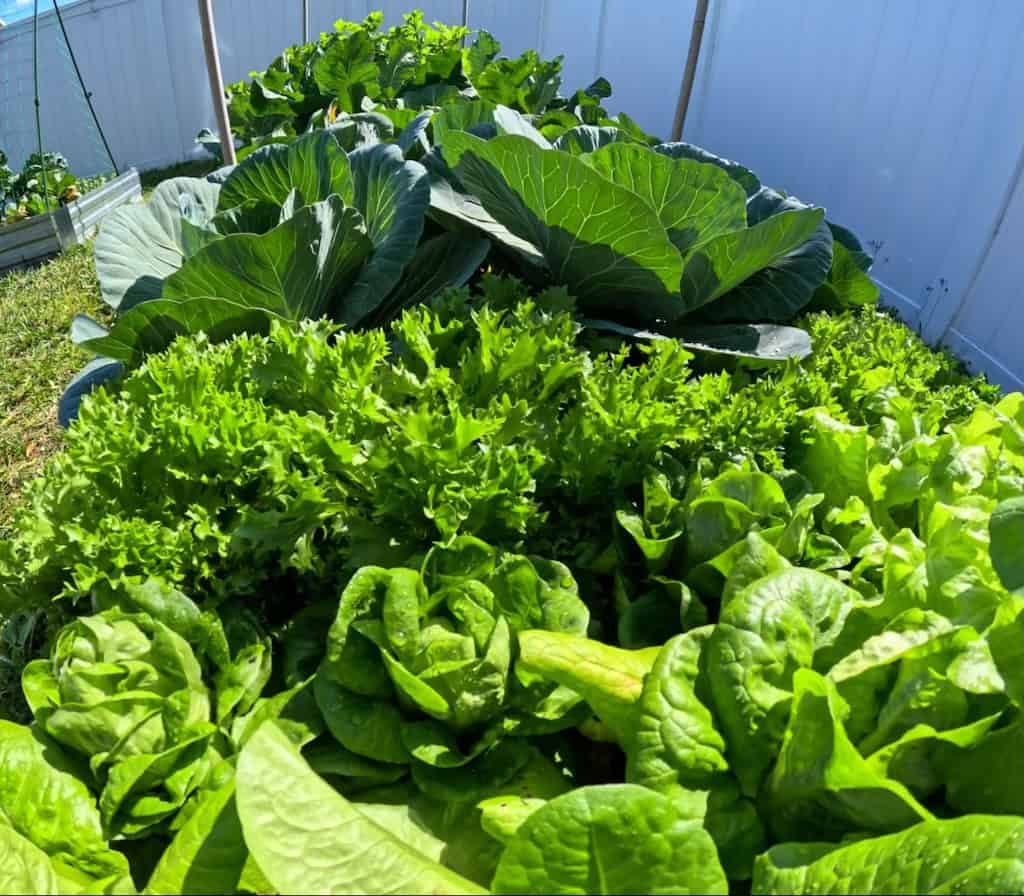
I almost made lettuce number one. It is ridiculously easy. Lettuce doesn’t need a ton of space, doesn’t require heavy fertilization, and gives you several different ways to grow it.
You can:
- Direct sow it
- Start it in seed trays
- Buy transplants
- Grow it in containers
- Grow it vertically
- Tuck it between larger plants
It doesn’t care how fancy your garden is. If your goal is low maintenance and fast production, I prefer loose-leaf lettuce over heading varieties.
A heading lettuce needs time to create the entire head before you harvest it. Loose-leaf lettuce doesn’t.
Once the plant has several good-sized leaves, I can start harvesting the outer ones while leaving the center intact. Then it grows more. It’s the same basic cut-and-come-again idea we use with kale and collards, except lettuce is much faster. You can begin harvesting some loose-leaf varieties in around 30 days.
Plant enough of them and you don’t need a mature head of lettuce. Take a few leaves from this plant, a few from that plant, and suddenly you have a salad.
Lettuce likes some nitrogen, but it isn’t a particularly demanding plant. If you’ve prepared reasonably healthy garden soil, you may not need to do much at all. And lettuce seed is tiny. One packet can contain an absurd number of seeds.
You can take a little handful, scatter them across an open area, keep everything moist while the seeds germinate, and a month or so later there’s lettuce everywhere. That’s about as hands-off as gardening gets.
Except for number one.
#1 Green Onions
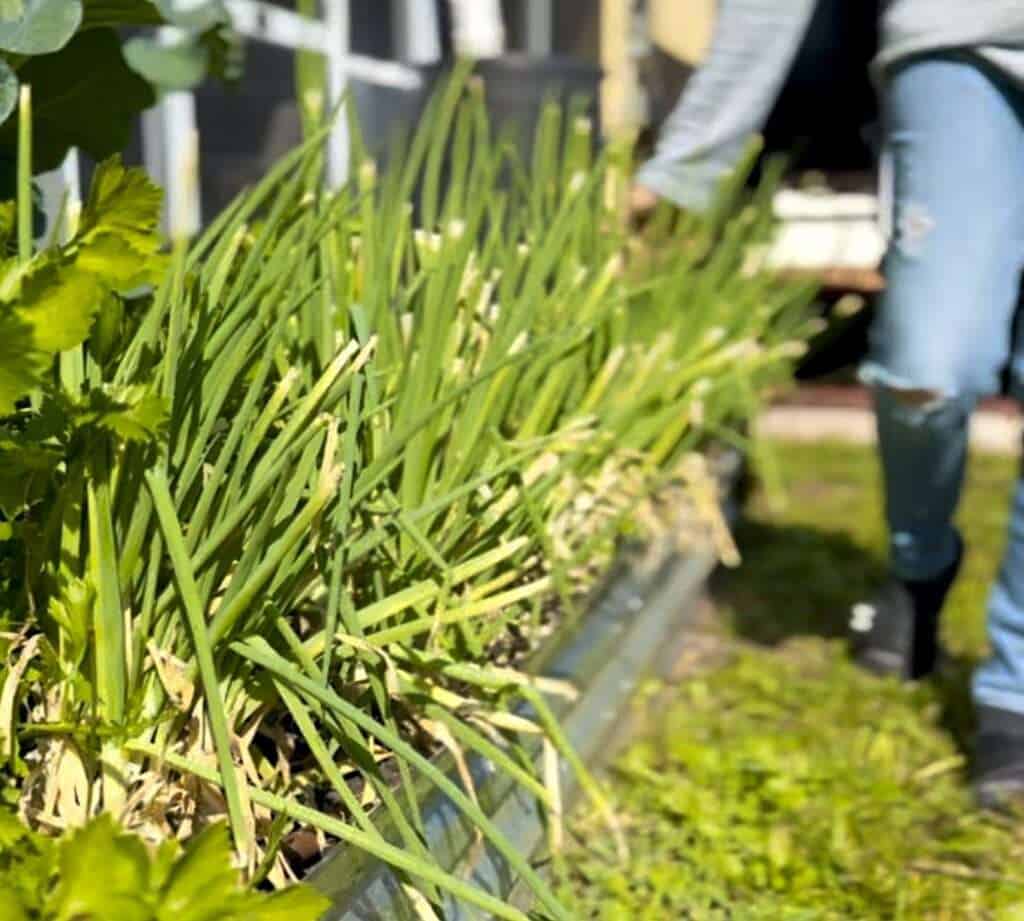
Green onions win. And to be clear, I’m talking about green onions or scallions, not the large bulbing onions you buy at the grocery store.
Bulbing onions have their own requirements, particularly when it comes to choosing the correct day-length variety for your location.
Green onions are much simpler. They’re one of the closest things I’ve found to a plant-it-and-forget-it vegetable. You can direct sow them. They’re tiny, so they fit almost anywhere. They grow quickly. They don’t require a lot of maintenance. And every time you cut them, they grow back.
But here’s where green onions get even easier. Go to the grocery store. Buy a bundle of green onions. Use them for dinner. Then take the white bottoms with the roots still attached and plant them in your garden. They’re going to start growing again.
Those tiny little grocery-store scallions can eventually become surprisingly large plants if you leave them in the garden. You can continue cutting the green tops whenever you need them and allow the base to remain in the soil. It just keeps producing.
I wouldn’t necessarily choose the dead heat of summer to establish brand-new green onion plants, but once they’re growing, mine can keep going through an enormous portion of the year. Plant them in fall, winter, or spring and let them establish. Then harvest what you need. If you leave them alone long enough, they’ll get larger and eventually produce flowers.
And those flowers produce seeds. So now the green onion you bought from the grocery store, ate, replanted, harvested repeatedly, and allowed to flower can give you seeds to grow even more green onions. For the price of one bunch, you could theoretically keep yourself supplied with green onions for years. That’s hard to beat.
Another reason I love them is that I can use green onions in almost any recipe where I would normally use an onion. If I want a stronger onion flavor, I use more of the white portion. If I want something milder, I use the green tops. So if a recipe calls for a sweet onion, red onion, or another bulbing onion and I don’t happen to have one, I’ll use what I have growing outside.
Green onions take almost no garden space, require very little attention, continually regrow after harvest, and can even be started from something you bought for dinner.
That’s why they’re number one on my list.
The Best Garden Is One You Actually Have Time to Grow
There’s nothing wrong with growing vegetables that require more work. I grow broccoli. I grow cauliflower. I grow plenty of things that need me to fertilize, prune, trellis, protect them from pests, or check on them constantly.
But your entire garden doesn’t have to be that way. If life is particularly busy, choose vegetables that give you more food for less effort.
Grow collards or kale and harvest from the same plant for months. Tuck radishes and lettuce into little empty spaces instead of dedicating entire beds to them. Grow pole beans vertically so a handful of plants can give you a huge harvest. Plant peas with your kids because the seeds are big and forgiving.
And stick some grocery-store green onion bottoms in the dirt. You don’t have to have hours available every day to grow food.
Sometimes the smartest thing you can do is choose vegetables that don’t care how busy you are.