Last Updated on June 22, 2026 by Homegrown Florida
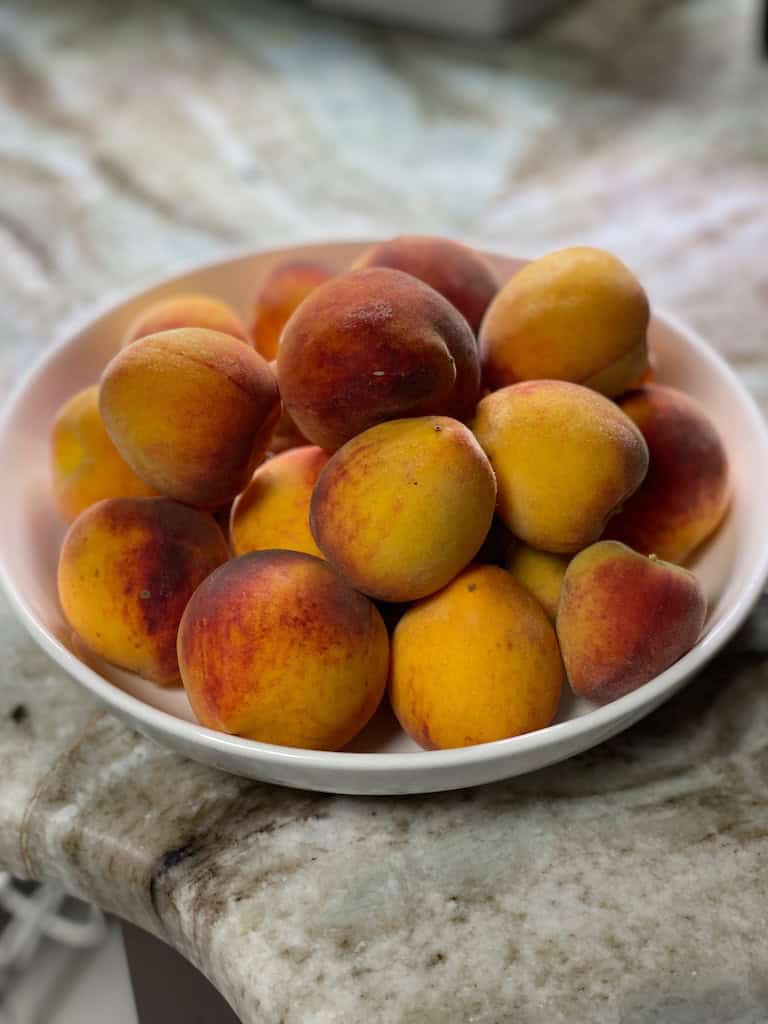
Most people are surprised when they see me growing peaches in Florida. Peaches are usually associated with places like Georgia and the Carolinas, not a hot and humid garden just north of Tampa. Yet every year, my peach tree produces more fruit than my family can eat fresh. We can peaches, freeze them, make desserts, and still end up sharing them with friends and neighbors.
That doesn’t mean peaches are easy.
Out of all the fruit trees I grow, growing peaches in Florida require some of the most attention. Choosing the right variety, understanding chill hours, managing pests, pruning, fertilizing, and watering at the right time all play a role in whether you end up with a basket full of peaches or a tree full of disappointment.
My peach tree, affectionately named Peachy, has been with me for more than seven years. She moved with me from my previous home, survived unusually cold winters, drought conditions, squirrel attacks, and more than a few gardening experiments. Along the way I’ve learned a lot about what works, what doesn’t, and what I would do differently if I were planting my first peach tree today.
If you’re considering growing peaches in Florida, here’s everything I’ve learned after seven years with Peachy.
Table of Contents
This post may contain affiliate links. Read full disclosure here.
Can You Really Growing Peaches in Florida?
Absolutely.
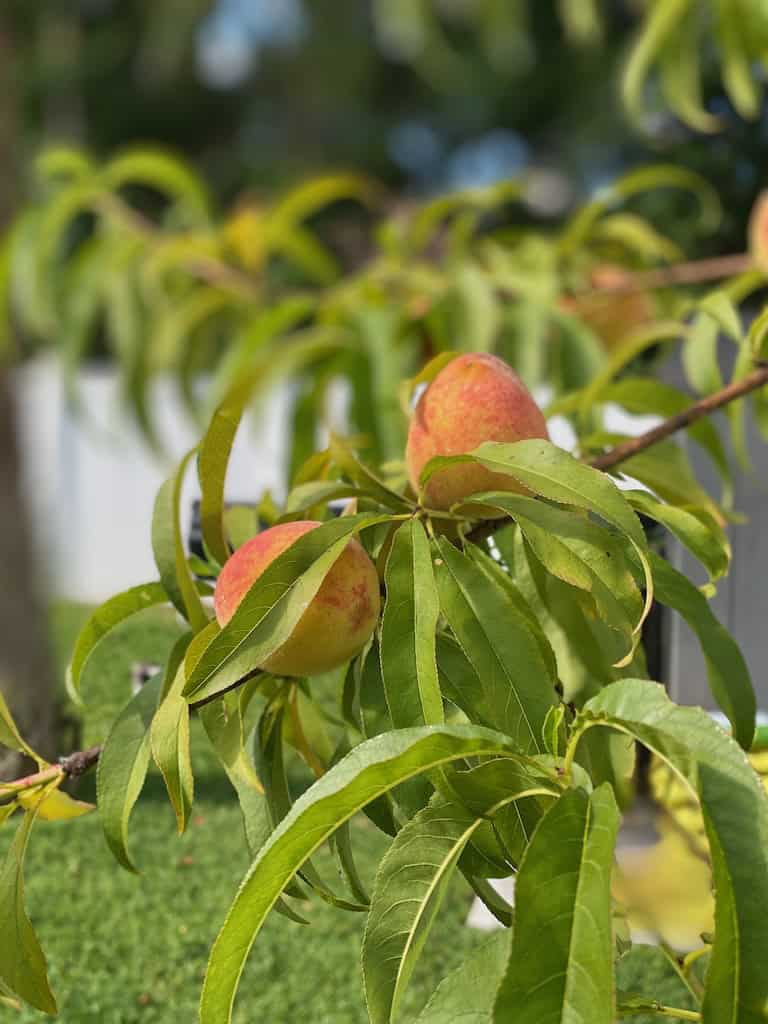
The challenge isn’t whether growing peaches in Florida is possible. The challenge is choosing varieties that are adapted to Florida’s winters. Most peach varieties sold across the country need long, cold winters to produce fruit. Those trees may survive here, but they often won’t produce reliably because they never receive enough winter chill.
Florida gardeners need low-chill varieties that were specifically bred for warm climates. Once you choose the right variety, peaches become surprisingly productive.
Understanding Chill Hours
The single most important thing you can learn about growing peaches in Florida is chill hours. Chill hours are the number of hours a tree experiences temperatures below 45°F during winter. Peach trees use those cool temperatures to properly break dormancy and prepare for spring growth.
Many traditional peach varieties require 600 to 1,000 chill hours each year. Most of Florida never gets close to that. My area in Central Florida typically receives somewhere between 250 and 300 chill hours. This past winter was unusually cold and we received closer to 450 chill hours.
That difference matters.
If you choose a peach tree that needs more chill hours than your area provides, the tree may survive but it won’t perform the way you expect. Flowering can be inconsistent, fruit production may suffer, and the tree can struggle year after year.
Before purchasing a peach tree, take the time to learn your local chill hour range and match your variety accordingly.
Choosing the Right Peach Variety
Peachy is a Tropic Beauty peach. This variety was developed specifically for Florida conditions and typically requires only about 150 to 250 chill hours.

That makes it an excellent choice for much of Central Florida and even parts of South Florida. The interesting thing about low-chill peaches is that finding the right balance matters. If you’re farther north in Florida, you’ll easily meet the chill hour requirements. However, you also have to consider flowering time.
Peach trees bloom very early.
Mine often flowers in February, which means late winter cold fronts can still be a concern. Peach blossoms are more cold tolerant than some fruit trees, but a hard freeze at the wrong time can still damage flowers and reduce your harvest.
The best peach variety isn’t necessarily the one with the lowest chill requirement. It’s the one that matches both your winter temperatures and your spring weather patterns.
Meet Peachy: My Tropic Beauty Peach Tree
Peachy has been with me for at least seven years and possibly closer to eight. She started life in a container before eventually moving into the ground at my current home. Since then she’s become one of the most productive fruit trees in my backyard.
Every year she reminds me why I keep growing peaches in Florida despite the extra work. The flavor is outstanding.
Store-bought peaches are often picked before they’re fully ripe so they can survive shipping. Homegrown peaches are a completely different experience. When allowed to ripen on the tree, the sweetness, aroma, and texture are hard to beat.
That’s what keeps me coming back year after year.
Keeping Peach Trees Small
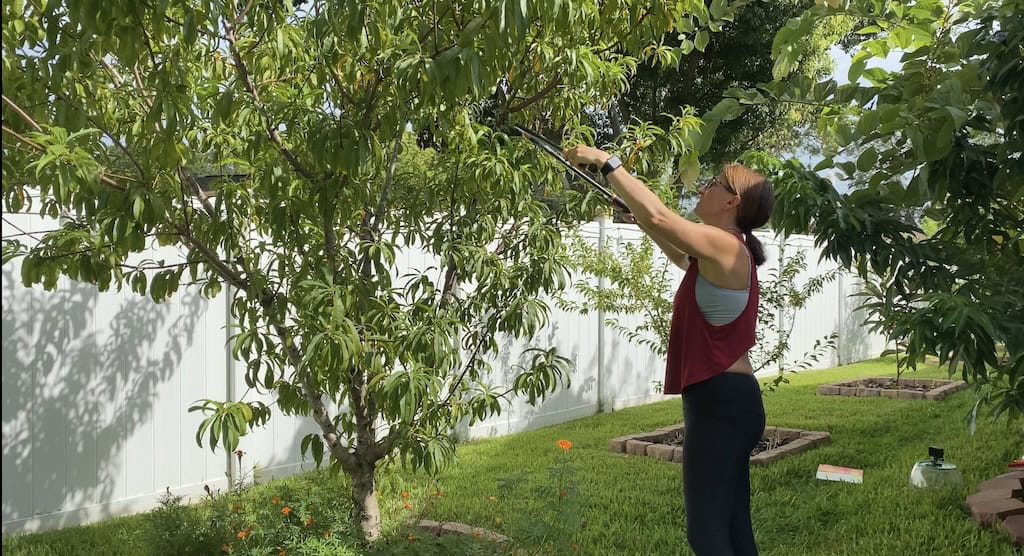
One of the biggest misconceptions about fruit trees is that they need to become enormous. They don’t.
I garden on a quarter-acre lot, and a large portion of that space is occupied by my pool and other garden projects. If I allowed all of my fruit trees to reach their natural size, I would run out of room very quickly.
A book called Grow a Little Fruit Tree completely changed the way I approach fruit trees. The concept is simple. Rather than allowing a tree to reach its full size, you use strategic pruning to maintain a smaller, more manageable tree.
Some gardeners keep peach trees as short as five or six feet tall. Peachy got away from me a little before I adopted this approach, so she now stays around twelve feet tall. Even at that size, she produces more peaches than my family can comfortably use in a year.
The reality is that smaller trees produce less fruit than full-sized trees. But for most backyard gardeners, a slightly smaller harvest is a worthwhile trade-off for easier maintenance and harvesting.
My Pruning Schedule
I prune Peachy twice each year. The first pruning happens during winter dormancy after all the leaves have dropped. This is where I focus on structure and shape. Peachy is trained into an open-center or vase shape. Instead of maintaining a central trunk, the center of the tree is opened up to allow sunlight and airflow throughout the canopy.
This helps improve fruit production and reduces disease pressure.
The second pruning happens during summer. This pruning is much less about shape and much more about controlling height. Peach trees grow aggressively during the warm season, and without regular pruning they can quickly become too tall to manage.
By combining winter and summer pruning, I can keep Peachy productive without allowing her to completely take over the yard.
Fertilizing Peach Trees in Florida

Peaches are heavier feeders than many of my other fruit trees.
Trees like mulberries and loquats seem perfectly content with very little attention. Peach trees demand more.
I typically fertilize twice each year. The first application happens when the tree begins waking up and flower buds start appearing. The second application happens after harvest is complete.
At that point, the tree has spent a tremendous amount of energy producing fruit and needs nutrients to recover and prepare for the following season. I’ve had good success using fruit tree fertilizers such as Jobes Fruit & Citrus and Vigoro Citrus & Avocado fertilizer.
Timing matters just as much as the fertilizer itself. I avoid pushing excessive growth late in the season because I know much of that growth will simply be removed during winter pruning.
Pest Problems and How I Manage Them
Peaches are probably the most pest-prone fruit tree in my garden. The biggest issue is worms that burrow into the fruit.
To prevent damage, I begin spraying Spinosad once fruit has formed and flowering is complete. I continue applying it periodically throughout fruit development. I always spray in the evening when pollinators are no longer active.
The goal is not to eliminate every insect. The goal is simply to protect the harvest while minimizing unnecessary treatments.
Squirrels are another challenge. Every year I seem to have one squirrel that decides my peaches belong to him. What drives me crazy isn’t that he eats the peaches. It’s that he takes one bite and moves on to the next one.
I’ve found that maintaining water sources around the yard can sometimes reduce wildlife pressure on fruit, especially during dry periods.
Then there are Sri Lanka weevils. By late summer they chew small notches into many of the leaves. Years ago I tried fighting them aggressively. Now I’ve accepted that some damage is simply part of gardening in Florida.
A healthy, established tree can tolerate surprisingly large amounts of cosmetic damage.
Watering During Fruit Production
One of my biggest lessons this year involved watering. For most of the year, Peachy survives entirely on rainfall. I don’t baby her. I don’t hand water regularly. I simply let her do her thing.
However, this year we experienced an unusually severe drought. At the same time, I noticed my peaches were staying smaller than normal. The lack of water clearly impacted fruit size.
I’ve since started supplementing with additional water every few days during fruit development, and I’ve already noticed improvement. Going forward, I plan to provide supplemental irrigation much earlier in the fruiting cycle. The lesson was simple.
Peach trees can survive drought.
That doesn’t mean they’ll produce their best fruit during drought.
Do You Need to Thin Peaches?

After years of thinning peaches, I decided to run an experiment. This year I barely thinned any fruit at all. The result was immediate.
I have more peaches than ever, but they’re noticeably smaller. Some branches became so overloaded that I had to support them with ties to prevent breakage.
In previous years, when I removed a portion of the fruit, the remaining peaches grew larger and easier to process for canning and preserving.
What I’ve learned is that there’s a sweet spot. You don’t need to remove huge amounts of fruit, but some thinning absolutely improves fruit size and overall tree health.
Next year I’ll go back to moderate thinning instead of skipping it altogether.
Final Thoughts
Growing peaches in Florida isn’t quite as simple as planting a tree and walking away. But after seven years with Peachy, I can tell you they’re absolutely worth the effort.
There’s something special about harvesting peaches from your own backyard when most people assume it can’t be done. Every spring I find myself watching the flowers, checking the developing fruit, and counting down the days until harvest.
Despite the pruning, fertilizing, pest management, and occasional squirrel battles, peaches remain one of my favorite fruit trees to grow.
And every year when I bite into that first ripe peach of the season, I’m reminded exactly why.