Last Updated on June 20, 2026 by Homegrown Florida
Florida blueberries are one of those fruits that make a lot of Florida gardeners nervous. They have a reputation for being difficult, and honestly, they can be if you treat them like every other fruit tree in your garden.
I’ve been harvesting fruit from my backyard every month this year, and Florida blueberries are my big harvest for May. After years of trial and error, I’ve learned that blueberries can thrive in Florida if you understand a few key things about how they grow.
The biggest mistakes I see people make are planting the wrong varieties, ignoring chill hours, and trying to grow them in soil that simply isn’t acidic enough. Once you understand those three things, blueberries become much easier to grow.
Table of Contents
This post may contain affiliate links. Read full disclosure here.
Why Blueberries Can Be Challenging in Florida
Blueberries naturally prefer conditions that are a little different from what much of Florida provides.
They want acidic soil, plenty of moisture, and a certain amount of winter chill before they’ll flower and fruit properly. Florida can provide the chill hours in many areas, but our soils are often too alkaline for blueberries to thrive.
When I first started growing Florida blueberries, I planted them directly in the ground. They slowly declined, lost leaves, and looked worse every year. Eventually I pulled them out and moved them back into containers where I could better control the soil conditions.
That decision completely changed how well they performed.
The Most Important Thing: Soil Acidity
If there is one thing you need to understand about blueberries, it is soil pH.
Most fruits and vegetables grow happily in soil with a pH somewhere around 6.0 to 7.0. Blueberries are different. They prefer soil between about 4.5 and 5.5.
Many Florida soils naturally sit closer to 7.0 because of our sand and underlying limestone. That difference may not seem huge, but to a blueberry plant it is the difference between thriving and struggling.

Because of this, I grow my blueberries in containers instead of in the ground.
My potting mix consists primarily of peat moss mixed with pine-based materials such as pine bark, pine shavings, or pine needles. These materials naturally help maintain the acidic conditions blueberries prefer.
I also occasionally use soil acidifiers when needed, but I always do so carefully. It’s much easier to lower pH gradually than it is to fix soil that has become too acidic.
Why I Prefer Containers
Growing blueberries in containers gives me far more control over their environment.
I can:
- Control soil acidity
- Control watering
- Adjust nutrients more easily
- Move plants when necessary
- Protect fruit from birds
For many Florida gardeners, containers are simply the easiest path to success.
If you happen to live near a pine forest or have naturally acidic soil, growing blueberries in the ground may work well for you. But for most of us, containers remove a lot of potential headaches.
Understanding Florida Blueberries Chill Hours
The second thing Florida gardeners need to understand is chill hours. Chill hours are the number of hours each winter that temperatures remain below 45°F.

Different blueberry varieties require different amounts of winter chill before they will flower and fruit properly. Some varieties need only 100 hours. Others may require 1,000 hours or more.
If you choose a variety that needs more chill hours than your area receives, the plant may grow just fine but produce very little fruit.
That’s why selecting the right variety for your region is so important. As a general rule, Florida gardeners should focus on low-chill southern highbush blueberries that have been developed specifically for warm climates.
The Blueberry Research Happening in Florida
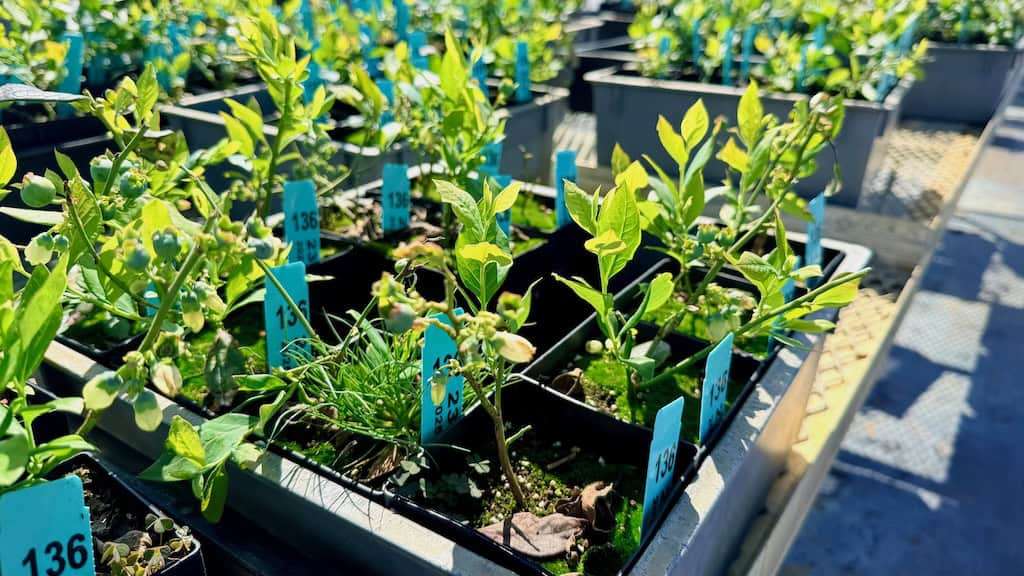
One of the most interesting experiences I’ve had recently was visiting research trials focused on blueberries.
Researchers are continually working to develop varieties that can handle Florida’s unique conditions. They are evaluating flavor, berry size, disease resistance, cold tolerance, and overall productivity.
What fascinated me most was seeing how much effort goes into developing blueberries that can handle both Florida’s occasional winter freezes and our long, hot summers.
The future looks very promising for Florida blueberry growers.
The Varieties I Grow
Sunshine Blue
Sunshine Blue has been one of the most reliable blueberries in my garden.
It produces well, tolerates Florida conditions, and has consistently given me good harvests. It is partially self-fertile, meaning it can produce fruit on its own, but I’ve noticed production improves when another variety is nearby.
Pink Lemonade
Pink Lemonade is my newest favorite. Unlike traditional blueberries, the fruit ripens to a beautiful pink color. I originally planted it to improve cross-pollination for my Sunshine Blue.
What I didn’t expect was how much I would enjoy the flavor. The berries are sweet, unique, and unlike any blueberry I’ve tasted before. After harvesting my first crop, I immediately understood why so many gardeners love this variety.
Do You Need More Than One Blueberry Plant?

Technically, no. Many blueberry varieties are self-fertile and will produce fruit on their own. However, I strongly recommend growing at least two compatible varieties whenever possible.
Cross-pollination often results in:
- Larger harvests
- Better fruit set
- Improved berry size
- More consistent production
My Sunshine Blue produced fruit by itself, but production noticeably improved once I added Pink Lemonade nearby.
Protecting Blueberries from Birds
Birds love blueberries almost as much as gardeners do. I normally share much of my garden with local wildlife, but blueberries seem to bring out a different level of enthusiasm.
As soon as the berries begin turning color, the birds start paying attention.
Because my blueberries are in containers, I can move them into my pool enclosure while the fruit finishes ripening. This simple step allows me to enjoy the harvest instead of donating it all to the neighborhood birds.
When to Harvest Blueberries
One of the easiest mistakes to make is harvesting too early. Blueberries begin changing color before they are fully ripe. Once they turn blue, I like to give them a little extra time on the plant whenever possible.
Fully ripe berries will:
- Have rich, full color
- Feel slightly softer
- Come off the plant easily
- Develop better flavor and sweetness
The wait is worth it.
Final Thoughts
If you’ve struggled with blueberries in Florida, don’t give up. Most problems come down to three things:
- Soil that isn’t acidic enough
- The wrong variety for your area
- Not understanding chill hour requirements
Once you address those issues, blueberries become surprisingly easy to grow.